Launch offer — valid today only

📄 Digital book in PDF · read it on your phone or print it

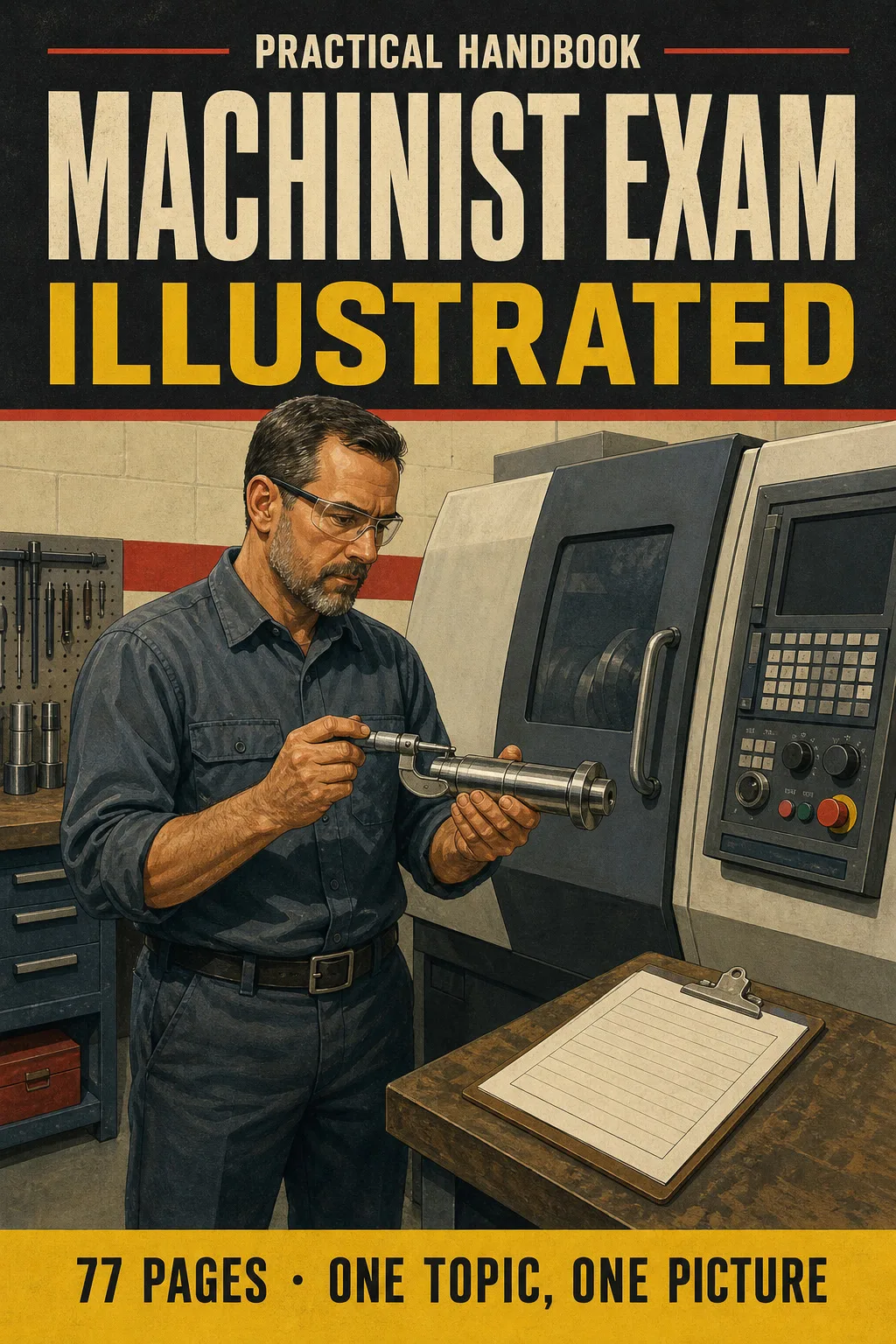
The Interprovincial Machinist Exam, Drawn: Read, Calculate and Set Up in the Same Order Every Time One Topic on Every Page

For the Red Seal interprovincial machinist exam. Blueprints, the vernier and the micrometer, trade math, tapers, threads and fits, milling, heat treatment and CNC programming, worked in metric. Every topic has its own page: the drawing first, then what you need to remember. 77 illustrated pages.

YES, I WANT THE ILLUSTRATED BOOK

🔒 Secure checkout · PDF by email · 30-day guarantee

Every topic, its own pageEvery formula and setup drawn, with the explanation right beside it
77 illustrated pages10 parts, from how the exam is built to the last-week checklist
Up-to-date sourcesRed Seal Occupational Standard for Machinist, ISO 286 / ISO 68-1 and WHMIS 2015
PDF by emailFormat

Look Inside the Book

Every page has one big drawing and a box with the numbers and formulas you need to know:

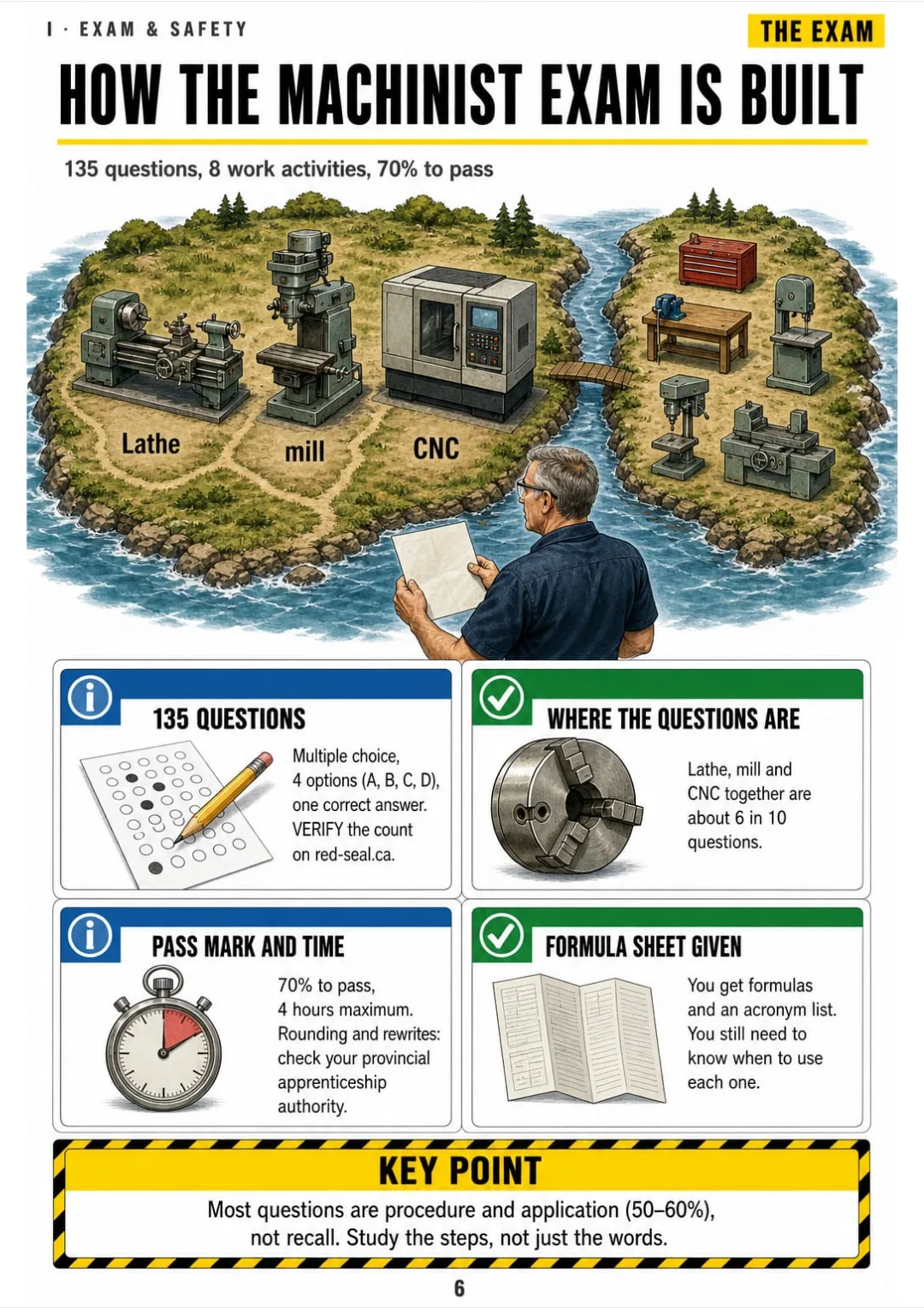
135 questions · 8 work activities (A–H) · 70% pass mark · 4 hours
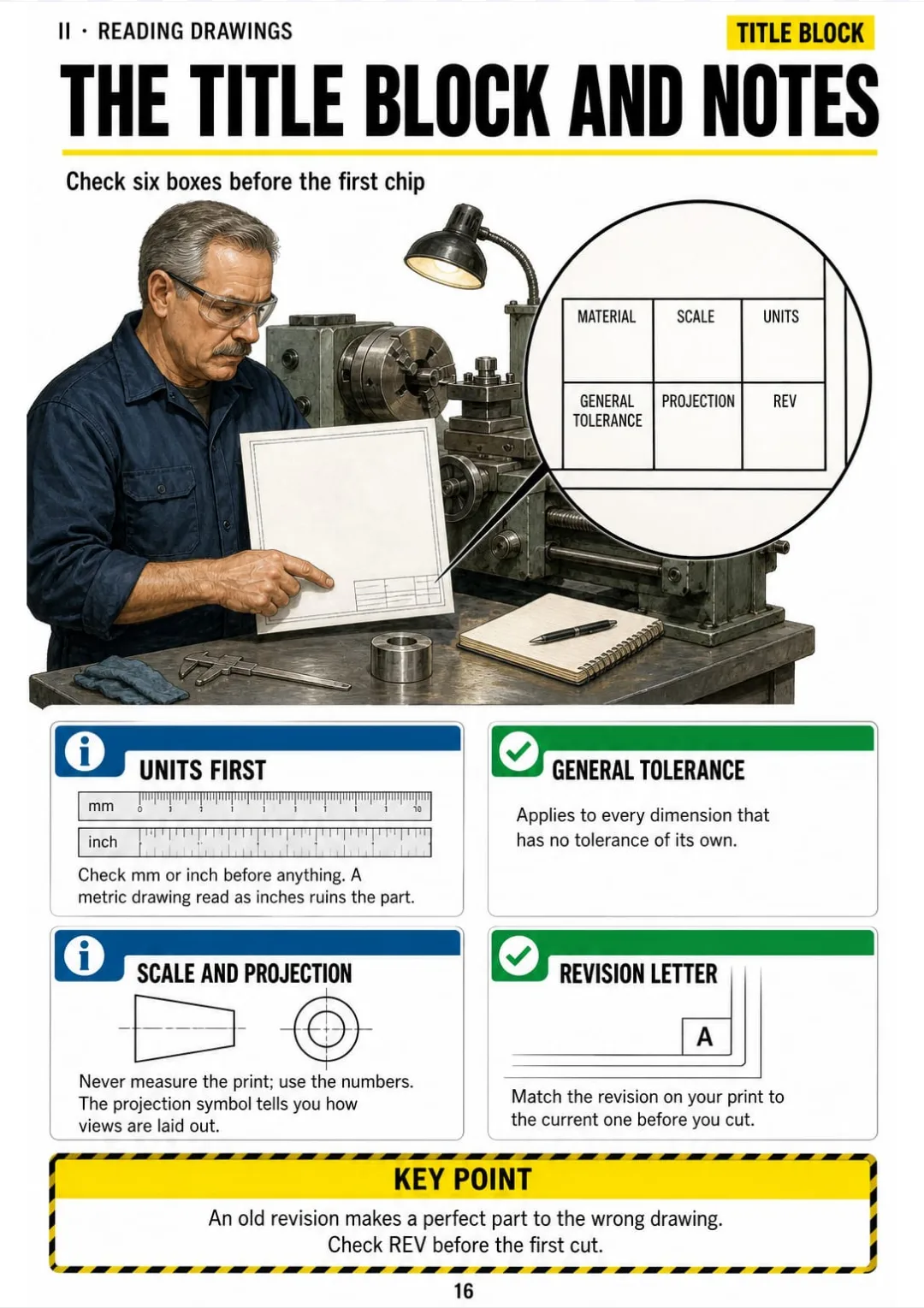
Material, scale, units, general tolerance, projection and revision: read them first.
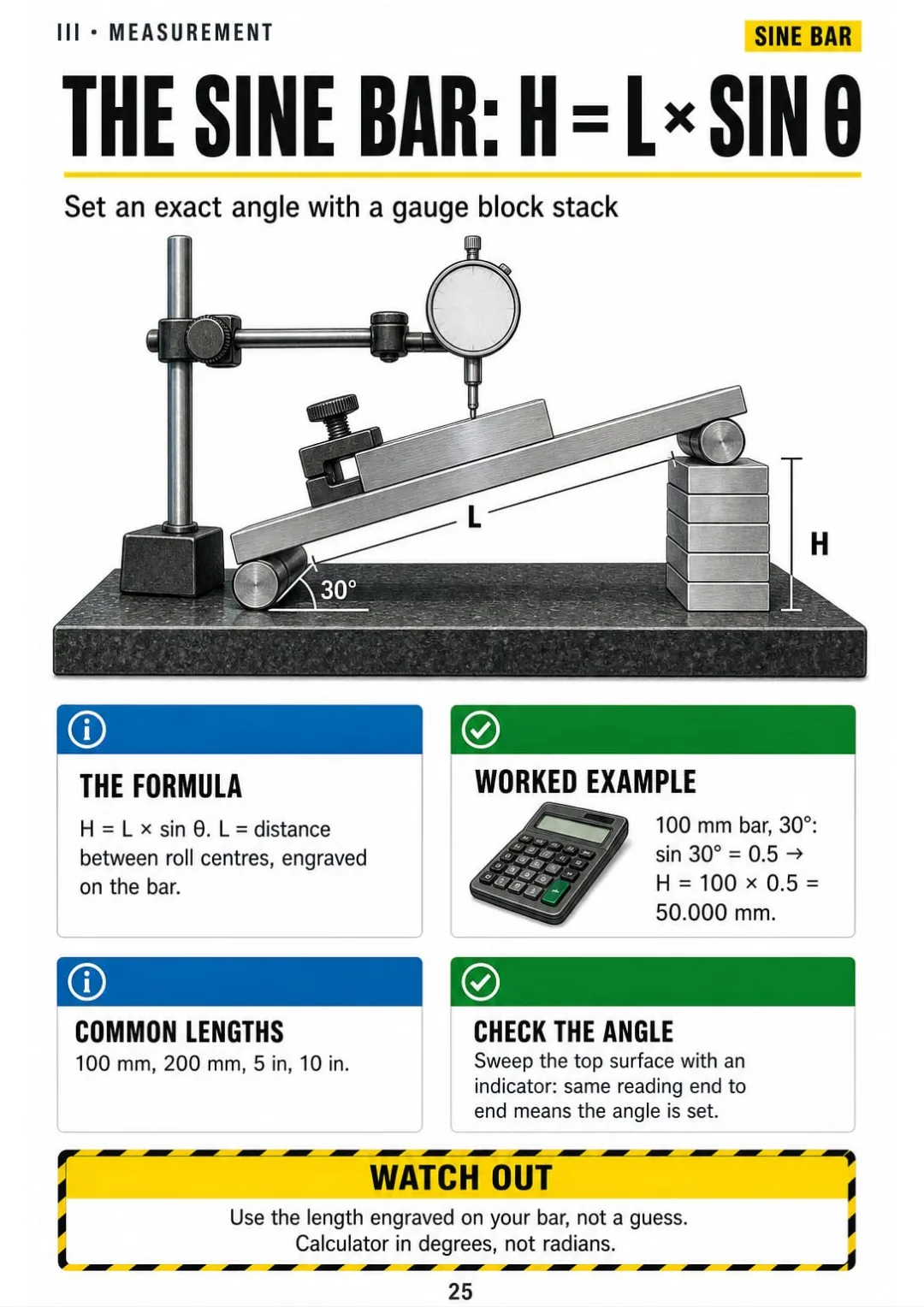
Sine bar: 100 mm × sin 30° = 50.000 mm stack
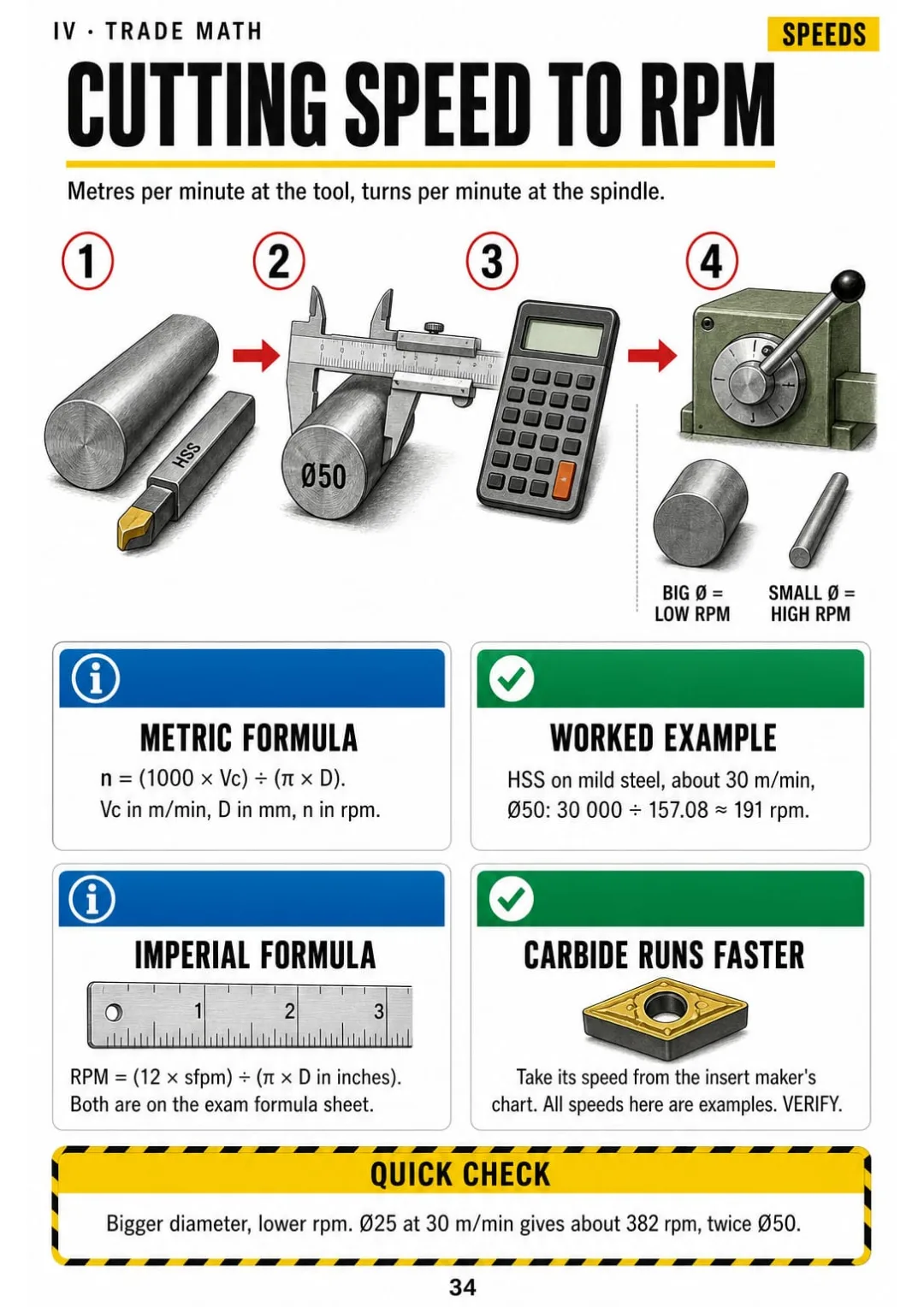
n = 1000 × Vc ÷ (π × D): 30 m/min on Ø50 ≈ 191 rpm.
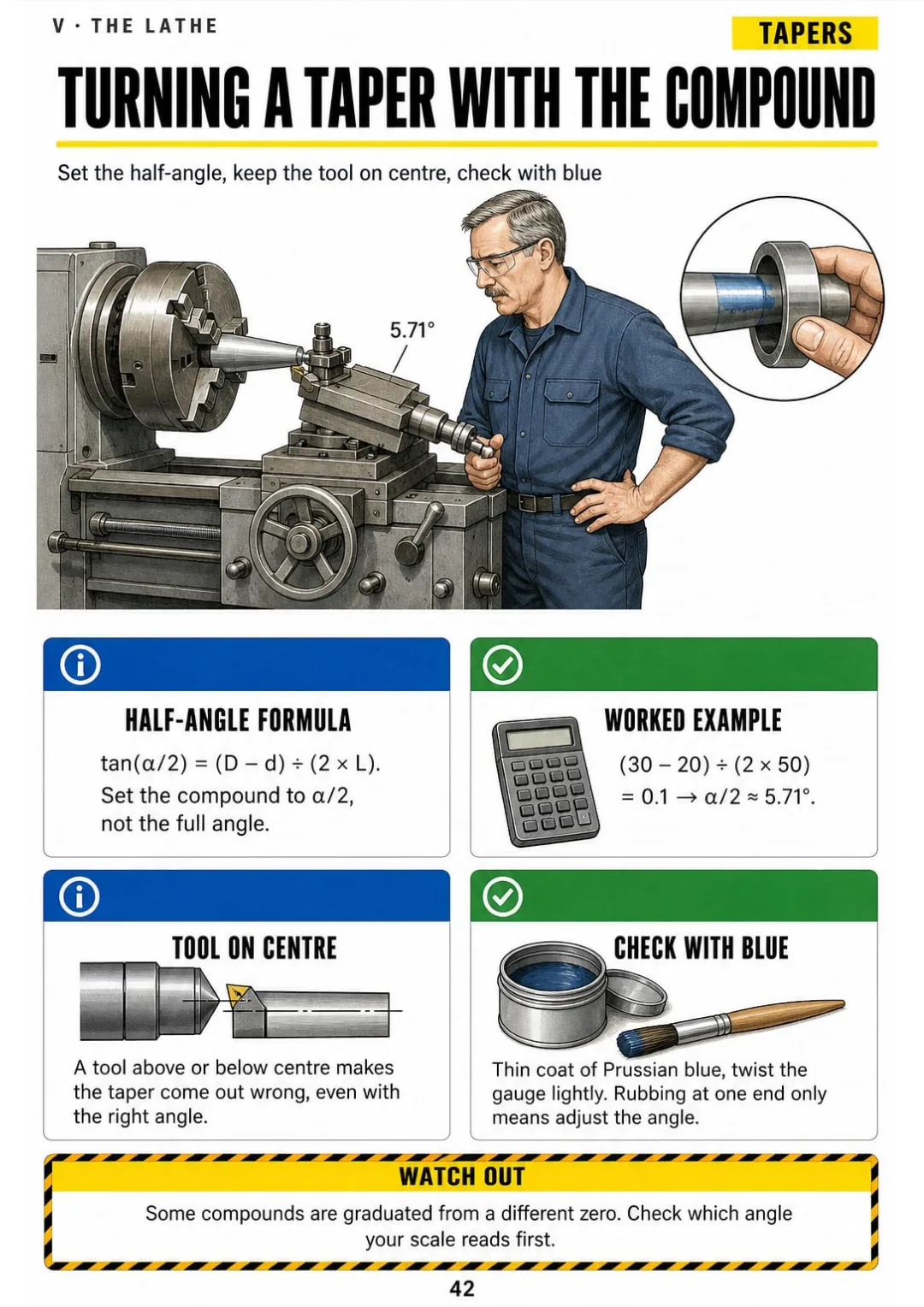
(30 − 20) ÷ (2 × 50) = 0.1 → set the compound to 5.71°
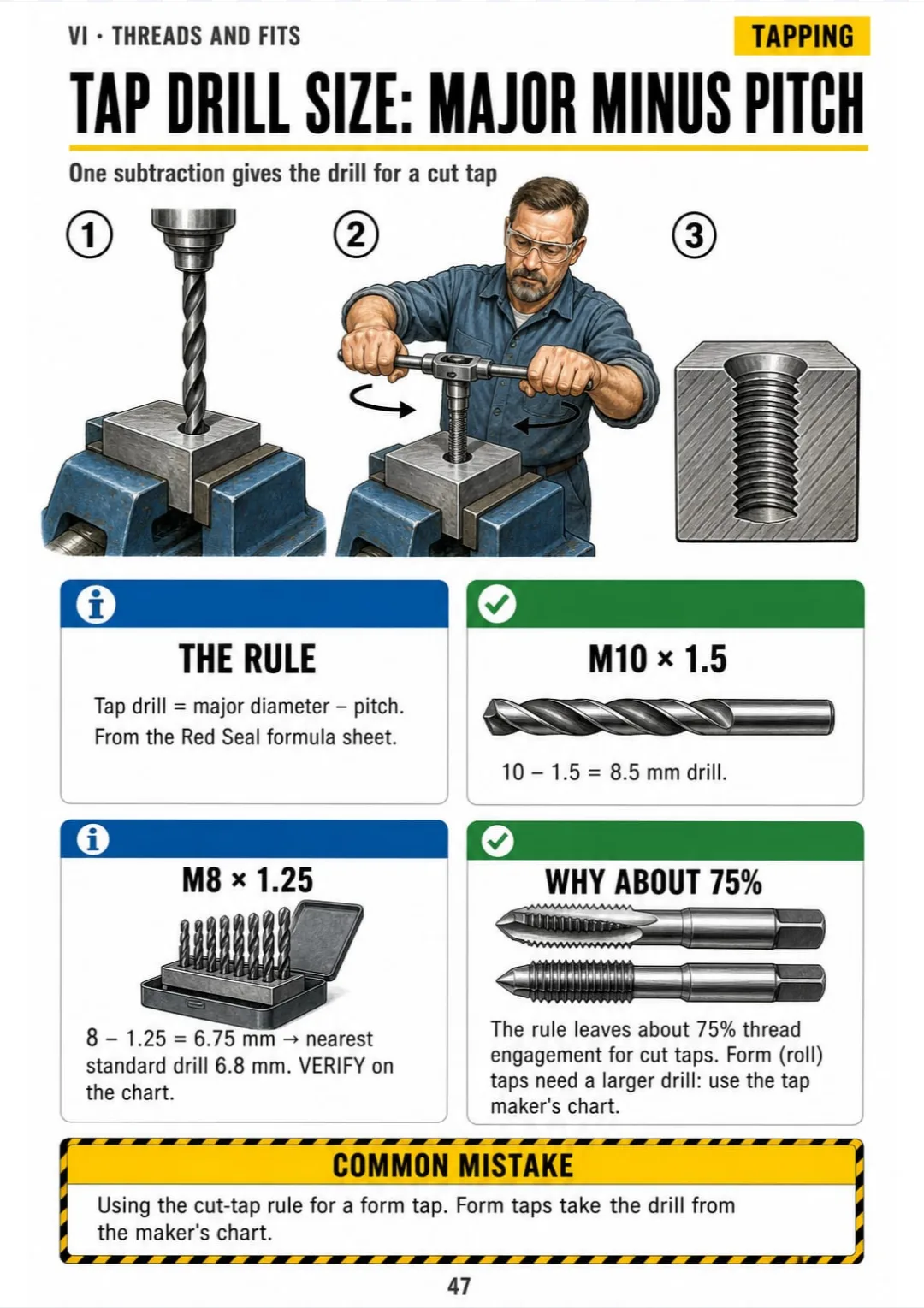
M10 × 1.5 → 8.5 mm drill · M8 × 1.25 → 6.8 mm drill
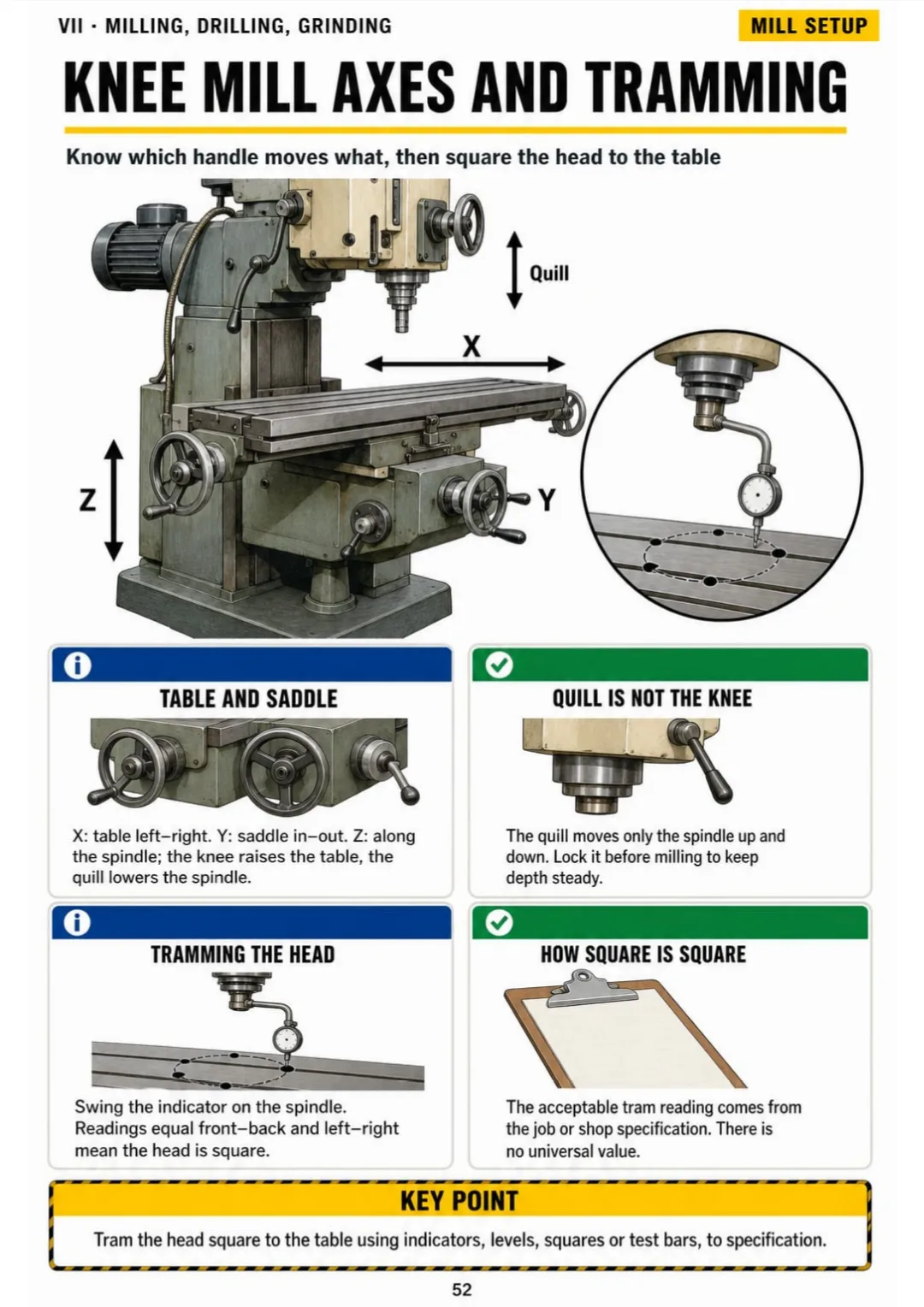
Knee mill axes X, Y, Z and quill, plus tramming: equal readings front–back and left–right.
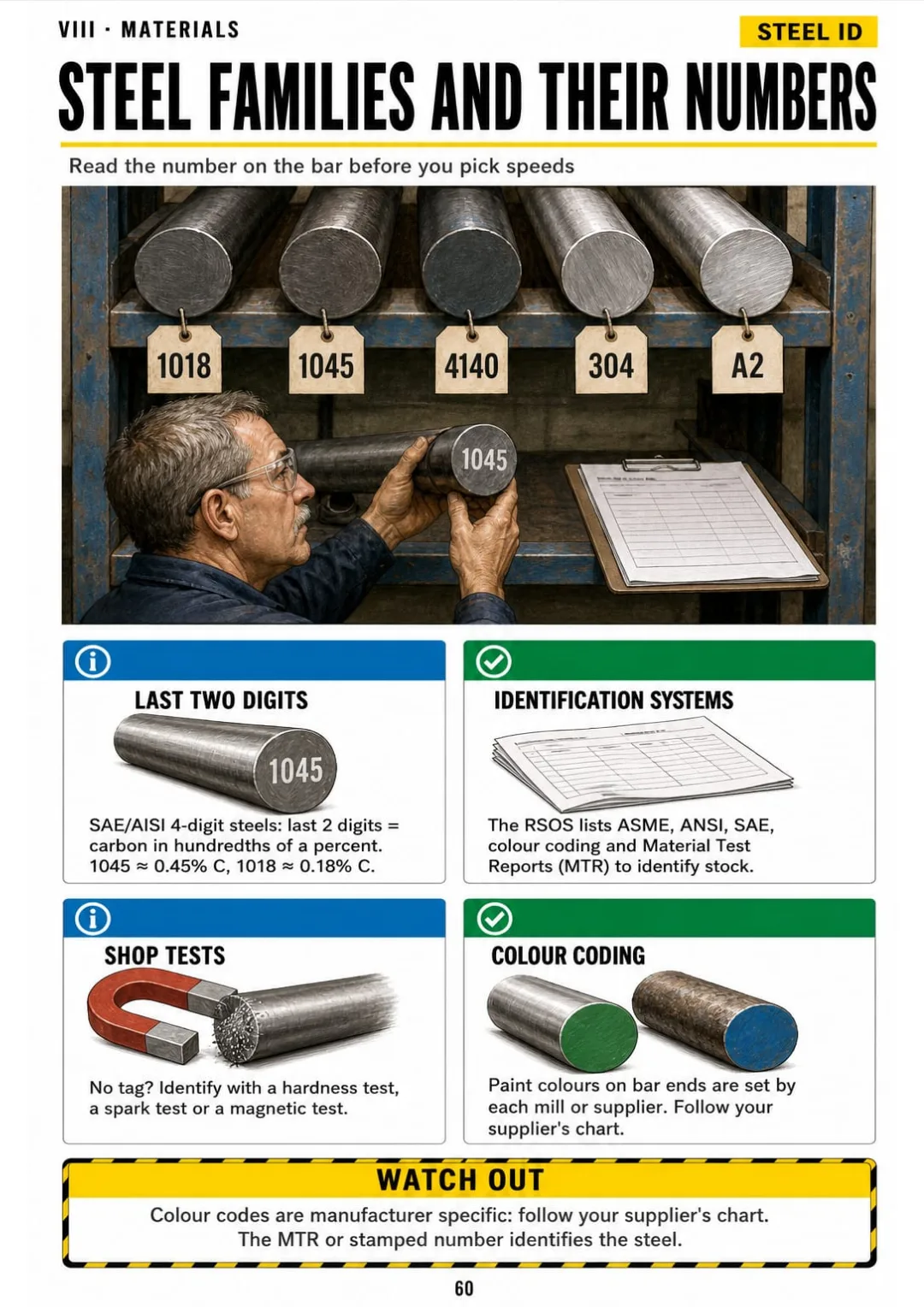
SAE 1045 ≈ 0.45% carbon: the last two digits are the carbon content

Swipe to see more →

These are real pages from the book. The table of contents is the full one: 10 parts and 72 topics.

The Problem Isn't You. It's How It Was Explained to You.

You're at the bench with a metric vernier caliper on a turned shaft, and the practice question wants the reading to two hundredths of a millimetre. You've done this for years at the machine, but on paper you freeze.

The textbook gives you a paragraph on main-scale divisions, vernier divisions and least count. Three sentences in, the numbers stop meaning anything.

Sine bar: 100 mm × sin 30° = 50.000 mm stack

In this book the caliper is drawn big: the main scale in millimetres, the one vernier line that lines up, and the sum written underneath: 23 mm + 17 lines × 0.02 mm = 23.34 mm. Read in the same order, every time.

The same goes for the micrometer thimble, taper per length, the bolt-hole circle, the three thread diameters and work offset vs. tool offset: each one has its own page.

You see how the reading is built, you understand why it works, and you take the next reading without going back to the textbook.

COMPARE FOR YOURSELF

The Same Topic, Two Ways to Study It

THIS
  • The textbook: line after line of text
  • Projection views explained with words only
  • You walk into the exam with doubts
In orthographic projection, the object is considered to be positioned within a system of mutually perpendicular planes of projection. In third-angle projection, the plane of projection is assumed to lie between the observer and the object, with the result that the top view is placed above the front view and the right-side view is placed to the right of the front view. In first-angle projection, the object lies between the observer and the plane, and the relative positions of the views are consequently reversed.
FOR THIS
  • Third-angle vs first-angle in one drawing
  • Where each view goes, in a box
  • You see it and you get it
Material, scale, units, general tolerance, projection and revision: read them first.
CONTENTS

Take a Look at the 10 Parts and 72 Topics

The exam and shop safety, reading drawings, measurement, trade math, the lathe, threads and fits, milling and grinding, materials, CNC programming and a final review: 77 pages, all illustrated.

IThe Exam and Shop Safety · pp. 6-11
  1. How the Machinist Exam Is Built
  2. How to Use This Book in 6 Weeks
  3. Lockout Before You Touch the Machine
  4. WHMIS 2015 Labels on Cutting Fluids
  5. Chips, Guards and PPE at the Lathe
  6. Lifting and Rigging Heavy Workpieces
IIReading Drawings · pp. 12-19
  1. Third-Angle vs First-Angle Projection
  2. Line Types That Tell You What You See
  3. Section and Auxiliary Views
  4. Dimensions and Tolerances: Limits, Plus/Minus, Unilateral
  5. The Title Block and General Notes
  6. GD&T: The Feature Control Frame
  7. GD&T: Form and Orientation Symbols
  8. GD&T: Position, Runout and MMC
IIIMeasurement and Inspection · pp. 20-27
  1. Reading a Metric Vernier Caliper
  2. Reading a Metric Micrometer in 3 Steps
  3. Inch Micrometer, Because Shops Still Use It
  4. Dial Indicators and Test Indicators
  5. Gauge Blocks: Building a Stack
  6. The Sine Bar
  7. Gauges: Plug, Ring, Thread and Go/No-Go
  8. Surface Finish: Ra in Micrometres
IVTrade Math · pp. 28-36
  1. Converting mm and Inches Without Errors
  2. Right-Triangle Trig: SOH CAH TOA at the Bench
  3. Bolt-Hole Circle Coordinates
  4. Taper Basics: Taper per Length and Angle
  5. Tailstock Offset for Long Tapers
  6. Measuring Dovetails and Vee Grooves with Rolls
  7. Cutting Speed to RPM
  8. Feed Rate on the Mill: fz × z × n
  9. Weight of a Part from Its Volume
VThe Lathe · pp. 37-44
  1. Lathe Parts and What Each One Moves
  2. Workholding: 3-Jaw, 4-Jaw, Collet, Between Centres
  3. Tool Geometry on a Turning Tool
  4. Carbide Inserts: Reading the Code
  5. Facing, Turning and Centre Drilling
  6. Turning a Taper with the Compound
  7. Knurling, Grooving and Parting Off
  8. Boring and Reaming on the Lathe
VIThreads and Fits · pp. 45-51
  1. Thread Anatomy: Major, Minor, Pitch Diameter
  2. Metric Thread Designation: M10 × 1.5 – 6g
  3. Tap Drill Size: Major Minus Pitch
  4. Thread Depth and Infeed on the Compound
  5. Unified Threads and Classes 1A-3A / 1B-3B
  6. Measuring Threads: Three-Wire and Thread Mic
  7. Hole-Basis Fits: H7/g6, H7/k6, H7/p6
VIIMilling, Drilling and Grinding · pp. 52-59
  1. Vertical Mill Axes and Tramming the Head
  2. Squaring a Block in 6 Sides
  3. Climb vs Conventional Milling
  4. End Mills, Face Mills and Slot Drills
  5. Indexing with a Dividing Head
  6. Drilling: Point Angle, Speeds and Countersinks
  7. Surface Grinding and Wheel Markings
  8. Bandsaw and Cutting Off Stock
VIIIMaterials and Heat Treatment · pp. 60-64
  1. Steel Families and Their Numbers
  2. Hardening, Quenching and Tempering
  3. Annealing vs Normalizing vs Stress Relief
  4. Hardness Testing: Rockwell C and B
  5. Machining Aluminium, Brass and Plastics
IXCNC Programming · pp. 65-73
  1. CNC Axes on the Lathe and the Mill
  2. Work Offset vs Tool Offset, Side by Side
  3. Absolute G90 vs Incremental G91
  4. G00, G01, G02, G03: Moving the Tool
  5. Cutter Compensation G41 and G42
  6. M-Codes You Must Know
  7. Constant Surface Speed on the Lathe: G96 and G50
  8. Reading a Short Program Line by Line
  9. Proving a Program Safely
XFinal Review · pp. 74-77
  1. Formulas on One Page
  2. The Most Common Calculation Mistakes
  3. How to Read a Multiple-Choice Question
  4. Last-Week Checklist

One Page, One Topic, All Clear

Think of it this way:

The exam question shows a bolt-hole circle: 6 holes on a 120 mm diameter. It asks for the X and Y of hole number 2.

You open the bolt-hole circle page and see the circle drawn, 60° between holes, the right triangle for hole 2 marked in colour and the working below: X = 60 × cos 60° = 30 mm, Y = 60 × sin 60° = 51.96 mm. Data, formula, calculation, check.

(30 − 20) ÷ (2 × 50) = 0.1 → set the compound to 5.71°

Same with the tailstock offset, the tap drill size, climb vs conventional milling, the dividing head and G41 vs G42: each one on its own page.

Machinist Exam Illustrated is 10 parts and 72 topics, all drawn, with every formula on one page and a last-week checklist at the end.

What you see drawn, you don't have to memorize.

What's Inside Machinist Exam Illustrated:

Ipp. 6-11

The Exam and Shop Safety

You know what the exam looks like before you write it: how it's built, a 6-week study plan, then lockout, WHMIS 2015 labels on cutting fluids, chips, guards, PPE and lifting heavy work.

IIpp. 12-19

Reading Drawings

Third-angle vs first-angle, line types, section and auxiliary views, tolerances, the title block and GD&T from the feature control frame to MMC.

IIIpp. 20-27

Measurement and Inspection

The metric vernier, the metric and inch micrometer, dial and test indicators, gauge blocks, the sine bar, go/no-go gauges and Ra surface finish.

IVpp. 28-36

Trade Math

Trade math you can run without notes: mm to inches, right-triangle trig, bolt-hole circles, tapers and tailstock offset, dovetails with rolls, cutting speed to RPM, mill feed rate and part weight, each worked out in metric.

Vpp. 37-44

The Lathe

Lathe parts, workholding, tool geometry, insert codes, facing and turning, tapers with the compound, knurling, grooving, parting off, boring and reaming.

VIpp. 45-51

Threads and Fits

Thread anatomy, metric designation, tap drill size, thread depth and infeed, Unified classes of fit, three-wire measuring and H7 hole-basis fits.

VIIpp. 52-59

Milling, Drilling and Grinding

Mill axes and tramming, squaring a block, climb vs conventional, cutters, the dividing head, drilling, surface grinding wheels and the bandsaw.

VIIIpp. 60-64

Materials and Heat Treatment

Steel families and their numbers, hardening and tempering, annealing vs normalizing, Rockwell C and B, and machining aluminum, brass and plastics.

IXpp. 65-73

CNC Programming

CNC axes, work vs tool offset, G90 vs G91, G00 to G03, cutter compensation, M-codes, G96 and G50, reading a program and proving it safely.

Xpp. 74-77

Final Review

All the formulas on one page, the most common calculation mistakes, how to read a multiple-choice question and a last-week checklist.

At the end of the book: Every formula on one page, the most common calculation mistakes and a last-week checklist.

Plus: 2 Free Books

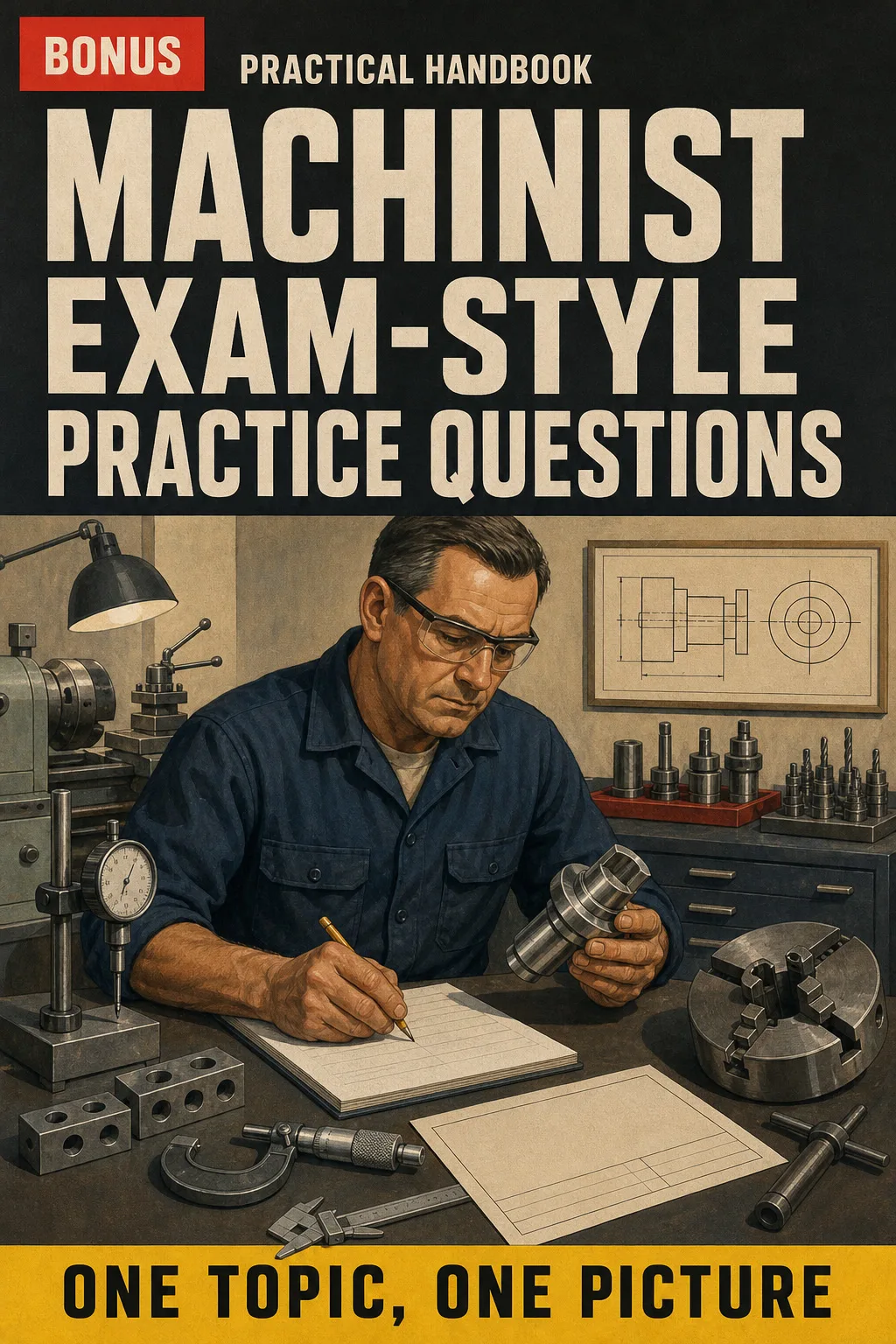
Machinist Exam-Style Practice Questions

BONUS 1: «Machinist Exam-Style Practice Questions»

Value on its own: US$ 17.90

Multiple-choice questions in the style of the trade exam, grouped by topic, with every answer explained, so you can find your weak spots before exam day.

15 Shop Mistakes: Before & After

BONUS 2: «15 Shop Mistakes: Before & After»

Value on its own: US$ 14.90

The most common machining mistakes drawn side by side with the right way to do it, a quick review to read the night before.

Machinist Exam Illustrated with 2 Free Books

  • Machinist Exam Illustrated: 77 illustrated pagesUS$ 63
  • BONUS 1: Machinist Exam-Style Practice QuestionsUS$ 17.90
  • BONUS 2: 15 Shop Mistakes: Before & AfterUS$ 14.90
  • High-resolution PDF to printIncluded
Total value US$ 95.80
YOUR PRICE:
US$ 27
You save US$ 68.80
YES, I WANT MACHINIST EXAM ILLUSTRATED FOR US$ 27

📄 This is a digital PDF book sent to your email: nothing is printed or shipped.

Secure purchaseEncrypted payment30-day guarantee

PDF by email: We email you Machinist Exam Illustrated as a PDF, together with the two free books. It's a single payment: no installments, no extra charges.

Who This Book Is For

You're in your last apprenticeship level

You're in your last apprenticeship level

Every topic from school, back in the same order, with the trade math worked out step by step in metric.

Your exam date is booked

Your exam date is booked

You review one page per topic, find your weak spots with the practice questions and go over the formulas page the week before.

You've been on the floor for 20 years

You've been on the floor for 20 years

What you already do at the lathe and the mill, explained for the exam: the why behind it, without starting from what a lathe is.

Everything You Get Today

US$ 95.80US$ 27
YES, I WANT MACHINIST EXAM ILLUSTRATED FOR US$ 27

📄 This is a digital PDF book sent to your email: nothing is printed or shipped.

30DAYS
GUARANTEE

30-Day Guarantee

Try Machinist Exam Illustrated for 30 days, bonus books included.

We refund everything if the file won't open, if the book isn't what you see here, if you were charged twice or if the email doesn't arrive. Just email us.

You pay once. No subscriptions.

Frequently Asked Questions

Is it for me if I've run a lathe for years but never written the exam?

Yes. It doesn't explain what a lathe is: it puts what you already do in order for the exam, with the why, the formulas and worked examples in metric.

Where does the content come from?

From the Red Seal Occupational Standard for Machinist, the standard behind the interprovincial machinist exam, plus the public exam information, ISO 286 / ISO 68-1 and WHMIS 2015. The worked examples are in metric, with inch conversions and Unified threads where the exam uses them. Speeds and feeds always refer to the tool manufacturer's data.

Is this official material?

No. It's an independent study book. It isn't issued, approved or endorsed by Red Seal, any provincial authority or CSA, and it doesn't give a certificate or count toward your hours: your ticket comes from your provincial apprenticeship authority once you meet its requirements, including the exam.

Does it replace my apprenticeship training or technical school?

No. It's a review book to study alongside your training and your hours on the floor.

Are the practice questions the real exam questions?

No. They're written for this book, in the style of a multiple-choice trade exam, so you can check what you know topic by topic.

When and how do I get it?

As a PDF by email, to the address you enter at checkout. The 2 bonus books come the same way.

Does it work in my province?

It follows the Red Seal Occupational Standard for Machinist, the base of the interprovincial exam. Check with your provincial apprenticeship authority how and when you write it. And it's a one-time payment, no subscription.

Can I have it on paper?

It's a PDF, not a printed book: nothing is shipped. It's made to print at home or at a print shop, so you can take the pages you need to the shop.

How does the refund work?

You have 30 days. We refund everything if the file won't open, if the book isn't what you see on this page, if you were charged twice or if the email doesn't arrive: just email us.

Before You Close This Page

No more rereading the textbook with nothing sticking.

The vernier, the taper and the work offset: you see them drawn, and that's it.

You walk into the exam knowing where everything is.

Drawings make studying faster.

The book is right below.

One-time payment: US$ 27 · Guarantee: 30 days · PDF by email

YES, I WANT MACHINIST EXAM ILLUSTRATED FOR US$ 27

📄 This is a digital PDF book sent to your email: nothing is printed or shipped.